How COE Quotas and Bidding Work
LTA sets a quota for each COE category every three months, based mainly on how many vehicles were deregistered. When more vehicles come off the road, more COEs are released in the next quota period. LTA also adjusts quotas for taxi numbers, expired COEs and replacements under the Early Turnover Scheme for commercial vehicles, so check LTA's quarterly quota announcement before you bid.
Prices are set through open bidding, held on the first and third Monday of each month. You state the most you're willing to pay, LTA ranks all bids from highest to lowest, and COEs go to the top bidders until the quota runs out.
Every successful bidder in that category pays the same price, called the Quota Premium (QP), which is the lowest successful bid.
What are the 5 COE Categories in Singapore?
Singapore's COE system groups vehicles by type and, for cars, by engine size and power output. Categories A and B are the most commonly bid for, while C, D and E serve more specific needs.
COE category | Vehicle classification | Vehicle type |
A | Non-fully electric cars up to 1,600cc and 97kW (130bhp)
Fully electric cars up to 110kW (147bhp) | Mid-range cars (e.g. Mazda 3 Sedan, MG4 EV, 7-seater Toyota Sienta Hybrid) |
B | Non-fully electric cars above 1,600cc or 97kW (130bhp)
Fully electric cars above 110kW (147bhp) | Larger or performance cars (e.g. BMW 3 Series, Audi A4, MG Cyberster EV, 7-seater Hyundai Palisade) |
C | Goods vehicles and buses | Business and commercial vehicles such as vans and lorries |
D | Motorcycles | Two-wheeled vehicles |
E | Open: all vehicles except motorcycles | Most flexible, but usually the highest-priced |
Disclaimer: Category A and B thresholds apply to COEs from the May 2022 1st bidding exercise onwards. Accurate as of 20 October 2026.
What engine size and power output mean for your COE category
Engine size is the engine's displacement, measured in cubic centimetres (cc). Power output is how much power the engine produces, measured in kilowatts (kW) or brake horsepower (bhp).
Petrol or diesel cars: Up to 1,600cc engines (1.6-litres) + up to 97kW (130bhp) maximum power output; exceeding either one moves it into Cat B.
Electric cars: No engine displacement; classified by up to 110kW (147bhp) maximum power output
⭐ Always confirm a specific model's category with the dealer or LTA's OneMotoring before you budget.
Why not bid for Category E?
Category E COEs are usually more expensive than Categories A and B because they're open to every vehicle type (except motorcycles). Dealers and businesses compete for them heavily, which makes them less cost-effective for most individual buyers.
During October 1st 2026 bidding exercise...
The COE closed at Category E ($137,000) vs Category A ($130,001) and Cat B ($130,100) marked a distinct $7,000 gap. Whether this is a small or significant price difference, the added competition ultimately outweighs any flexibility for a private car buyer.
COE price premium history per category
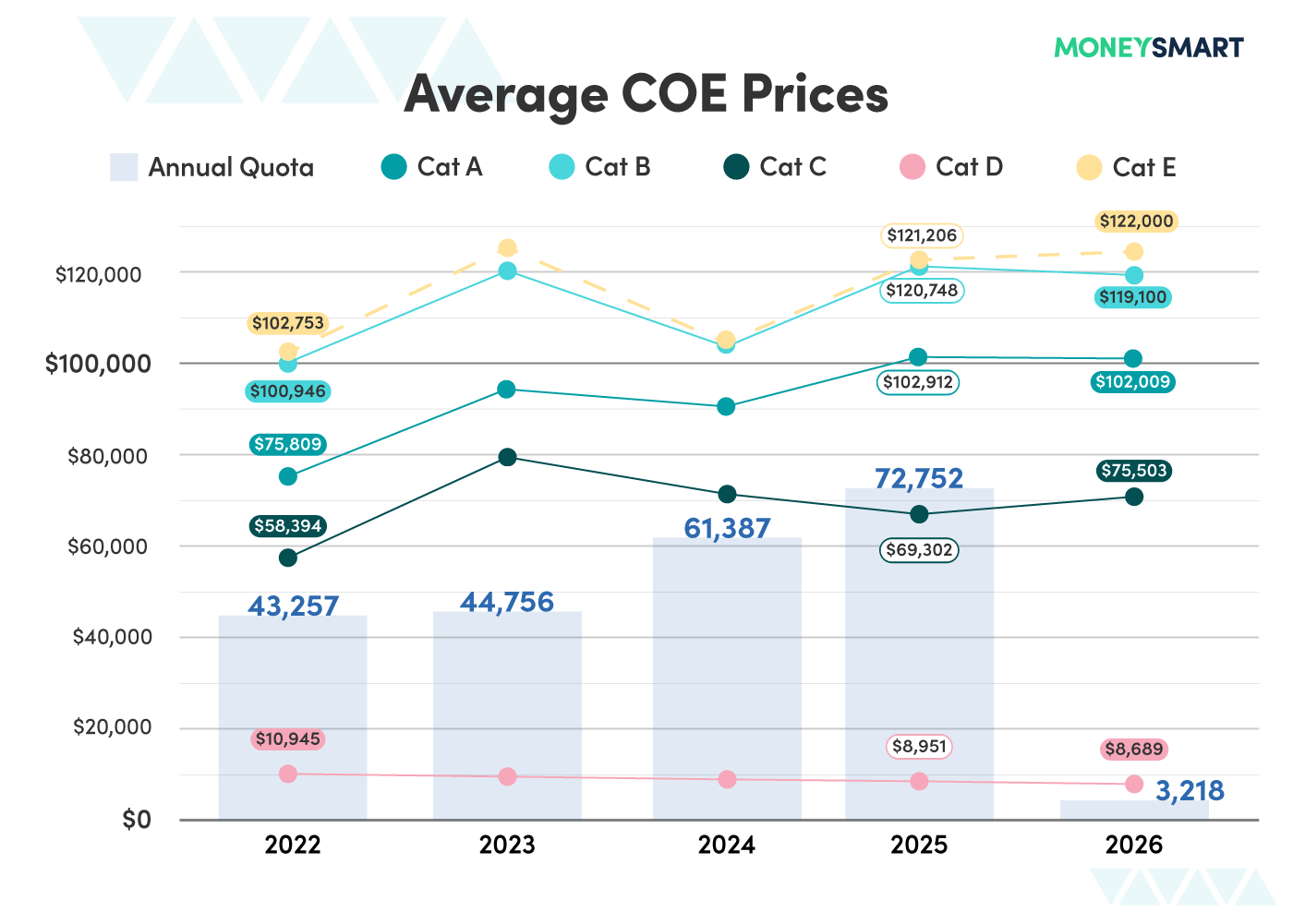
Updated as of January 2026
Source: coe.sgcharts.com
What does engine size and horsepower mean for the COE category?
A car’s engine size and horsepower (or power output) directly impact its COE category classification. For context, engine size refers to the engine’s displacement (measured in cubic centimetres “cc”) and power output refers to the engine’s performance (measured in kW “kilowatts” or bhp “brake horsepower”).
To qualify for Category A COE, your car must minimally meet these requirements:
Petrol or diesel cars: Up to 1,600cc engines (1.6-litres) + up to 97kW (130bhp) maximum power output
Electric cars: Up to 110kW (147bhp) maximum power output
Cars exceeding these thresholds will fall under Category B, which typically involve higher bidding prices.
Key Differences between COE car categories
Beyond vehicle type, COE categories differ in four ways worth knowing before you bid.
#1: Quota allocation
The number of COEs available differs by category in every bidding exercise.
Category A usually gets a larger share of the quota, since demand for affordable, mid-range cars from everyday drivers is higher.
Category C gets a smaller quota that changes over time, as fewer business/commercial vehicles are deregistered than private cars.
Category E draws intense competition from businesses, dealers and private bidders, so its supply rarely goes far.
#2: Bidding behaviour and buyer profiles
COE bidding is competitive in every category, but some are more volatile than others because of the buyers they attract.
COE category | Customer type | Reason for demand |
A | Individuals, families and private-hire drivers | More affordable, fuel-efficient cars for the mass market |
B | Relatively more affluent individuals | Luxury, large-capacity and high-performance vehicles |
C | Companies, business owners and dealers | Commercial vehicles like vans and lorries |
D | Motorcyclists | Motorcycles, including for delivery and courier work |
E | Dealers, companies, fleet owners, parallel importers and individuals | Flexibility to register any vehicle type (except motorcycles) |
MoneySmart Tip
Fleet owners are individuals or businesses that own multiple vehicles for operational use, such as rental car companies, delivery services and logistics providers. Parallel importers are third-party dealers that bring in cars not sold by authorised distributors in Singapore.
#3: Resale value impact
A vehicle's COE category can significantly affect its resale value. Generally, resale value ranks from strongest to weakest as Category B > A > E > C > D.
Resale ranking | Category | Why? |
1 (Best value) | B | Strong prestige and desirability, even as used cars Smaller but wealthier pool of buyers with strong demand
|
2 | A | More affordable, so it appeals to a wide base of practical buyers |
3 | E | |
4 | C | Depreciates faster due to heavier use, wear and tear, and business-related factors |
5 (Least value) | D | Smallest market and fastest depreciation |
MoneySmart Tip
Category A and B cars tend to hold their value better in a market downturn, while Category E cars can depreciate faster without sustained demand for luxury or niche models.
#4: Transfer eligibility
Not all COEs are created equal when it comes to transferability. Whether a COE can be transferred affects a vehicle's flexibility and resale appeal.
Category C and E COEs can be transferred once, but only if they were bid for under an individual's name.
Category A, B and D COEs can't be transferred.
COEs bid for under a company, business or organisation can't be transferred, whatever the category.
Separately, you can still sell a vehicle registered under a Category A or B COE, but only once it is more than 3 months from registration. At 4 to 6 months, an additional levy may apply.
In any category, the vehicle can't have outstanding financing or road tax arrears when ownership is transferred.
#5: Categorical pricing differences
COE prices are not uniform across all categories. Each category closes at different prices based on its own unique pricing dynamics influenced by the factors above.
In particular, Category B and E vehicles tend to see the most expensive COE prices. Category B tends to command higher Quota Premiums due to strong demand from affluent buyers for larger and higher-performance vehicles.
Similarly, Category E offers greater flexibility but experiences volatile prices, driven by prominent competition from dealers, parallel importers, and fleet buyers. While closing COE prices fluctuate month to month, this observation generally holds true.
What Affects COE Price Trends?
Several forces drive COE prices at once:
Supply and demand set the baseline. Supply is the quota LTA releases, and demand comes from individuals, businesses and dealers. When supply tightens, premiums tend to rise; when it grows, competition can ease.
Market conditions matter too. In a strong economy, more people and businesses bid aggressively, so premiums tend to spike; in a downturn, lower disposable income and weaker consumer confidence cut demand, and prices tend to fall.
LTA policy changes can shift demand quickly. Changes to how quotas are calculated, new vehicle schemes or tighter loan rules can all move prices before or during the next bidding round.
Bulk bidding by dealers and fleets adds concentrated demand. Car dealers and fleet buyers such as rental and leasing companies often bid aggressively for stock vehicles, particularly after festive seasons, which pushes prices higher and makes it harder for individual buyers to secure a COE during peak dealer activity.
Buyer behaviour keeps demand steady. For many Singaporeans, owning a car is about lifestyle as much as practicality, despite the efficient public transport, and that steady demand keeps upward pressure on premiums.
Common Mistakes to Avoid When Bidding for COE
Even seasoned drivers slip up when bidding for a COE. Here are the most common pitfalls.
#1: Underestimating the final cost
The Quota Premium is only part of the bill. First-time bidders often forget the registration fee, ARF, excise duty, GST and car insurance that come with buying and owning a car.
Some also forget that if their bid fails while their current COE is expiring, they may have to renew it at the Prevailing Quota Premium (PQP), which can exceed the current COE price.
#2: Bidding too aggressively or copying past prices
Many bidders assume they must match the latest COE price to win, and panic-bidding to secure a COE can lead to financial strain later. Every successful bidder pays the same Quota Premium, not their own bid.
Blindly copying past prices without understanding current demand makes you more likely to lose the bid or overpay, so set a realistic reserve price based on your budget and research and avoid reacting to every price swing.
#3: Assuming which category your vehicle falls under
Different variants of the same model can fall under Category A or B, so check your exact variant before you bid or compare loans.
SMEs buying dual-use vehicles should also confirm whether a model falls under Category A/B or C, as this affects both the premium and the financing available.
MoneySmart Tip
Always remember that the final QP is determined by the lowest successful bid within the available quota, not by matching a prevailing “target” figure. Set your reserve price strategically, factoring in market trends and demand patterns—not arbitrary numbers or emotions.
How Your COE Category Affects Your Car Budget and Loan
When COE premiums rise, so does a vehicle's total purchase price, and with it the loan you may need. Buyers usually respond by changing their choice of car, downpayment, loan size or timing, and the stakes are highest in Category B, where loans are already larger.
Using a car loan
Under Monetary Authority of Singapore (MAS) rules, how much you can borrow for a car loan depends on its OMV:
OMV of $20,000 or less: loan of up to 70% of the purchase price
OMV above $20,000: loan of up to 60% of the purchase price
The purchase price includes taxes and the COE, and car loan tenures are capped at 7 years.
Using a personal loan for COE
While less common, you can use a personal loan to help finance a car purchase or COE, since you decide how the funds are used. Rates, loan amounts and tenures vary by lender. Most tenures go up to 5 years, while some, such as the HSBC Personal Loan, go up to 7 years.
Disclaimer: *Assumes borrowing $10,000 over 1 year at the advertised EIR, excluding fees. POSB's figures use its flat rate, as it doesn't publish an EIR. Actual rates depend on your credit profile. Accurate as of 20 October 2026.
Loan Repayment Calculator
See how much you need to pay back per month
You can expect to pay:
S$ 2,124.00 / month
*estimated monthly payment
Total cost of loanS$ 50,976.00
Total interestS$ 976.00
⚠️ Do note that personal loan repayments add to your monthly debt.
When you also apply for a car loan (also called a hire purchase loan), lenders look at what you already owe each month. A large existing personal loan can therefore reduce the car loan you're approved for, so you may need to pay a bigger cash downpayment upfront.
COE Renewal: How PQP and Renewal Options Work
What is PQP?
When your 10-year COE expires, you can either deregister the vehicle or renew the COE by paying the Prevailing Quota Premium (PQP). The PQP is a moving average of the Quota Premiums in your vehicle's category over the last 3 months of bidding, so the PQP for a car is higher after a stretch of high premiums in that category.
MoneySmart Tips
If your vehicle was registered under a Category E COE, you must renew it under its matching category (A to D).
You can renew for:
10 years: pay the full PQP
5 years: pay 50% of the PQP; cars and motorcycles can only do this once and must be deregistered when it ends, while goods vehicles and buses can keep renewing in 5-year blocks until their statutory lifespan
Deregistering may entitle you to rebates, including the Preferential Additional Registration Fee (PARF) rebate and a rebate on any unused COE. Weigh the renewal sum against these rebates, a replacement vehicle's cost and your car's condition.
How to renew COE?
To finance a COE renewal, you can generally choose between a car loan and a personal loan. Some banks offer car loans for vehicles with revalidated COEs, while a personal loan is an alternative.
💡 Compare interest rates, tenures and borrowing limits across lenders, and use MoneySmart's personal loan comparison to review rates and eligibility in one place.


 Why Trust MoneySmart?
 (1).png)